Backyard projects
A backyard sauna shows up as a crate on your driveway. Here is everything that happens next.
No cutting, no special skills, one licensed electrician. Seven checks decide whether the build is a weekend or a month.
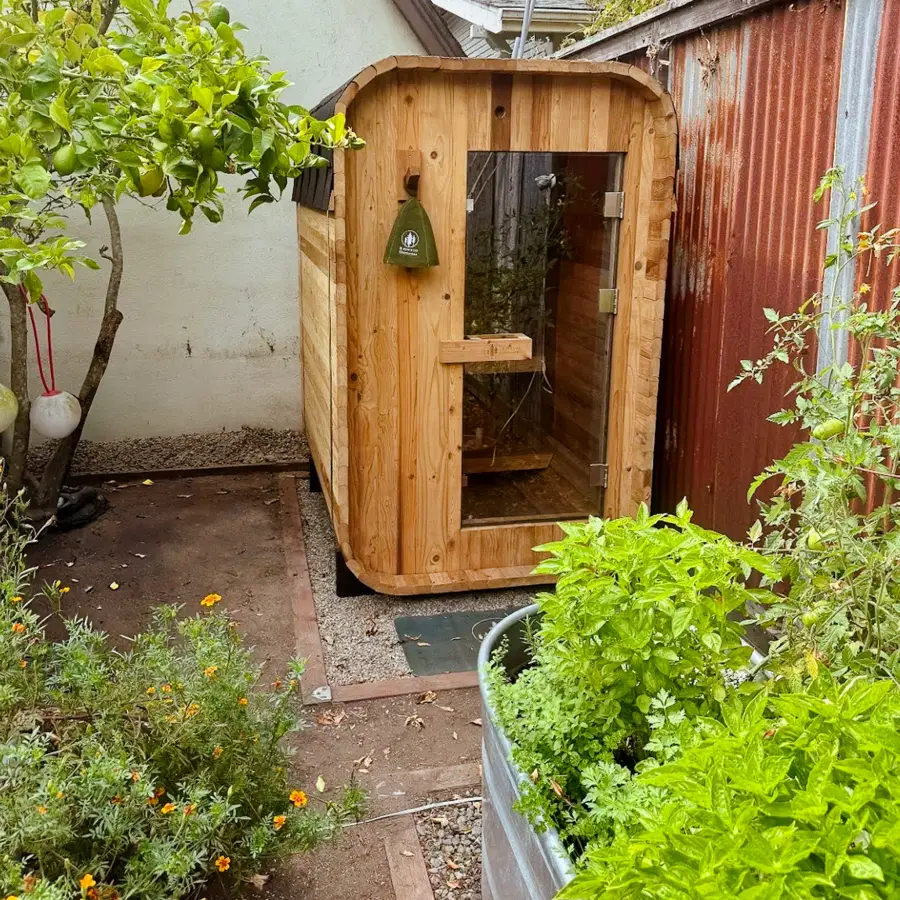
The pitch for a home sauna is easy to picture. The project behind it is not, and that is where most people stall. Not on whether heat is good for them. On whether this thing needs a contractor, a slab, a permit, and a month of weekends.
So here is the whole project, in order, using Redwood Outdoors' own published specifications. Their instructions are unusually blunt about what you do yourself and what you hand to a professional, which makes it possible to lay the thing out end to end without guessing.
The short version: you do the carpentry, a licensed electrician does the power, and the two jobs are almost entirely independent. Everything below is about not discovering that in the wrong order.
Look at your electrical panel before you look at your budget
This is the check that can end the project, so it goes first. A sauna heater is not an appliance you plug in. Redwood Outdoors states it plainly on every sauna page:
Sauna heaters do not plug into standard outlets and must be hardwired to your electrical panel. Redwood Outdoors, assembly and installation notes
Every outdoor model lists the same requirement: 120V for the interior lighting, 240V for the heater. What changes from heater to heater is the breaker, and that number is the one to carry to your panel before you spend anything.
Breaker required, by heater
Published electrical requirements for the heater packages sold alongside the outdoor saunas. The bar is the breaker size.
All figures published on the heater product pages at redwoodoutdoors.com. All are 240V. On the KIP 6kW the company adds that for runs over 30 feet from the breaker, #8 wire is recommended instead of #10.
Two practical consequences. First, a 50 amp circuit is a serious draw, and whether your panel has room for it is a question your electrician answers in about ten minutes. Ask that question before you choose a model, not after the crate lands. Second, the company is explicit about who does this work:
- A licensed electrician must be hired to install the heater. This is not presented as a recommendation, it is a condition.
- Redwood Outdoors advises getting at least two quotes from qualified providers, which tells you the spread on this line is wide enough to be worth shopping.
- The electrician's work is the only part of the project with a price you cannot look up in advance. Everything else on this page has a published number.
If your panel is full or the run to the yard is long, that is not a reason to abandon the project. It is a reason to know the figure now, because it changes the total by more than the difference between two sauna models.
See the heater options and their power requirementsBreaker size and wire gauge are listed on every heater page Check 2Measure the path from the curb, not the space in the yard
Almost everyone measures where the sauna will sit. Far fewer measure how it gets there, and that is the measurement that causes delivery day problems. Redwood Outdoors ships in a wooden crate on a freight truck, and describes the drop precisely:
Our shipments are delivered by a large freight truck, typically equipped with a liftgate. This allows the carrier to lower the crate to ground level upon arrival. This is a curbside delivery, meaning the crate is placed at the end of your driveway or nearest accessible location. Redwood Outdoors, shipping and delivery
Read that twice. The carrier's job ends at ground level at the end of your driveway. Getting from there to the pad is yours. So the number that matters is not the size of your yard, it is the narrowest gap between the curb and the spot: a side gate, a path between the house and the fence, a corner you have to pivot around.
Crate width, the number to beat
Published shipping dimensions. Compare the widest bar against the narrowest point on your route.
Shipping dimensions as published on each product page. Note that the Duo, the smallest sauna in the range by floor area, ships in a crate wider than both the Cove and the Barrel. Crate size does not track sauna size.
That last point is the one worth keeping. The smallest sauna does not arrive in the smallest crate. If access is your constraint, the crate table decides your model, not the seating count.
The crates weigh what a sauna weighs: 900 lb for the 6 person Barrel, 910 lb for the Duo, 1,000 lb for the Cove, 1,150 lb for the Cabin, 1,410 lb for the Garden. Nobody carries that. In practice the crate is opened where it lands and the panels are moved one at a time, which is exactly why the kit is built out of panels in the first place.
What to arrange before delivery day
Freight orders include an appointment required service, and carriers typically call ahead to schedule. You get two tracking links, one for transit to the local depot and one for the final curbside leg. Any adult at the address can accept the shipment. A missed delivery without prior arrangement can add fees, so the useful move is simply being reachable when the depot calls.
The pad is the only part you cannot redo later
Panels can come apart. A heater can be swapped. What sits underneath cannot be changed without dismantling the whole thing, which is why this is worth more thought than it usually gets. Redwood Outdoors approves four base types and sets one hard condition on all of them.
The four approved bases
Any of these is acceptable. The requirement they share is at the bottom.
All four are listed on the product pages. The condition attached to every one of them: the foundation must support the full weight of the sauna and all occupants.
That phrase is doing real work. A 4 person Cabin weighs 1,150 lb empty, and four adults add several hundred pounds on top of it. A deck built for a barbecue and two chairs is not automatically a deck built for this, and the moment to find that out is before the crate arrives, not while four people are inside.
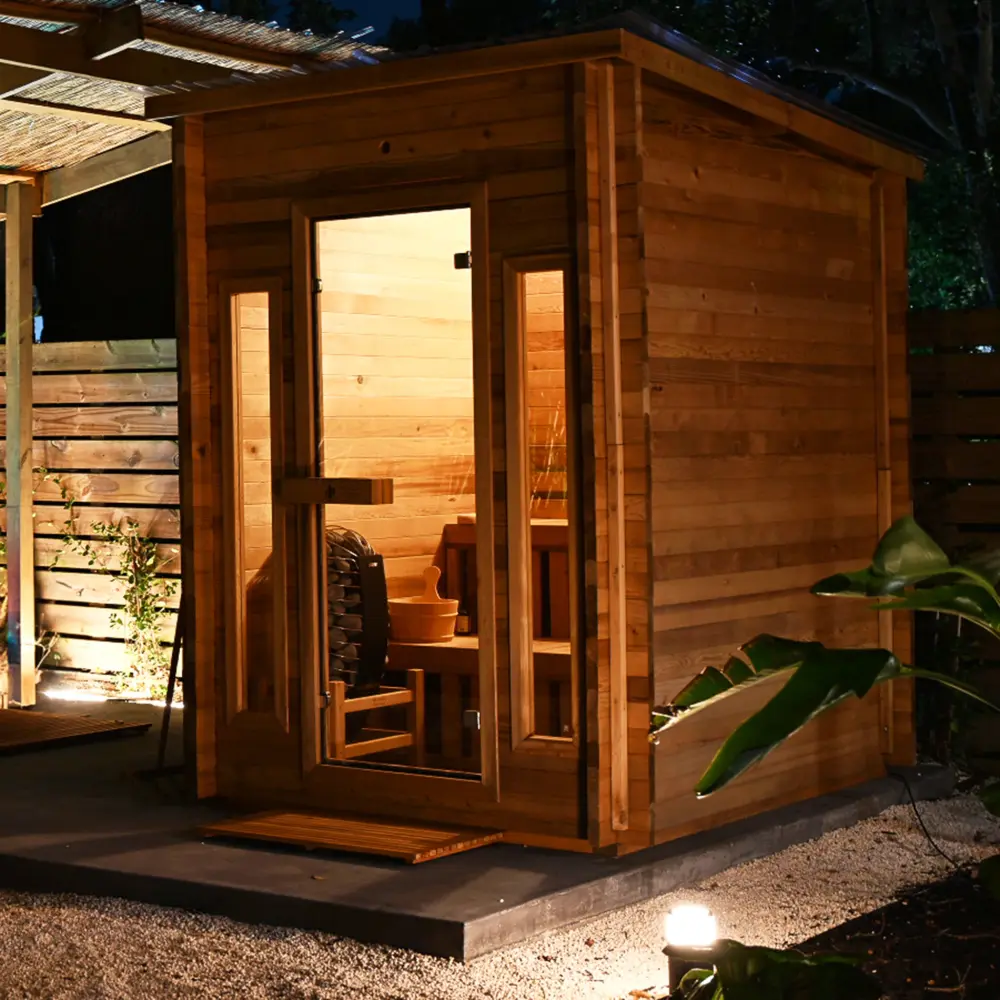
The site selection rules are short and worth reading as a checklist rather than prose. The location must be stable and level. It needs enough clearance around it to actually assemble the thing, not just to hold it once built. It has to drain. And it has to be within reach of your electrical connection, which loops straight back to Check 1: the further the sauna is from the panel, the more the wiring costs, and on the 6kW KIP a run beyond 30 feet already changes the recommended wire gauge.
Empty weight, before anyone gets in
Published weights for the outdoor range.
These are empty weights. The published requirement is that the base carries the sauna and all occupants, so the number your foundation has to hold is meaningfully higher than any bar above.
Start the permit conversation first, because it runs on someone else's calendar
Everything else on this list is your labor or your electrician's. This one is a queue, and queues have to be joined early. Redwood Outdoors does not claim you are exempt:
Depending on your location, a building permit or HOA approval may be required. Always check local regulations before starting installation. Redwood Outdoors, before you begin your sauna installation
That is the honest version, and it is the right one. Rules differ by city, by county and by association, and a company selling nationally cannot tell you which applies to your lot. What it does tell you is that the question exists, which is more than a lot of outdoor structures get.
The practical point is about sequencing rather than paperwork. The permit or approval question is the only step where you are waiting on someone with no reason to hurry. If it turns out you need nothing, you have lost a phone call. If it turns out you need something, you found out while the crate was still in a warehouse instead of while it was sitting on your driveway.
Check 5The build is six tools and panels that only fit one way
This is the part people brace for and it is, by the company's own description, the least dramatic step in the project:
Our saunas are built for easy DIY installation, with no cutting, modifications, or special skills required. Each kit includes pre cut, interlocking panels that fit together precisely, allowing you to assemble your sauna in just a few hours using basic construction skills. Redwood Outdoors, easy DIY sauna installation
No cutting is the load bearing phrase. It means no saw, no dust, no measuring twice, and no piece you can ruin by getting a cut wrong. The full recommended tool list is six items and you probably own five of them.
The entire tool list
Recommended tools, as published. Nothing here is a specialty purchase.
A printed assembly manual specific to your model ships inside the crate, and digital manuals plus assembly videos are published online. Because the designs keep changing, the company asks you to follow the printed instructions in your crate rather than a video you watched last year.
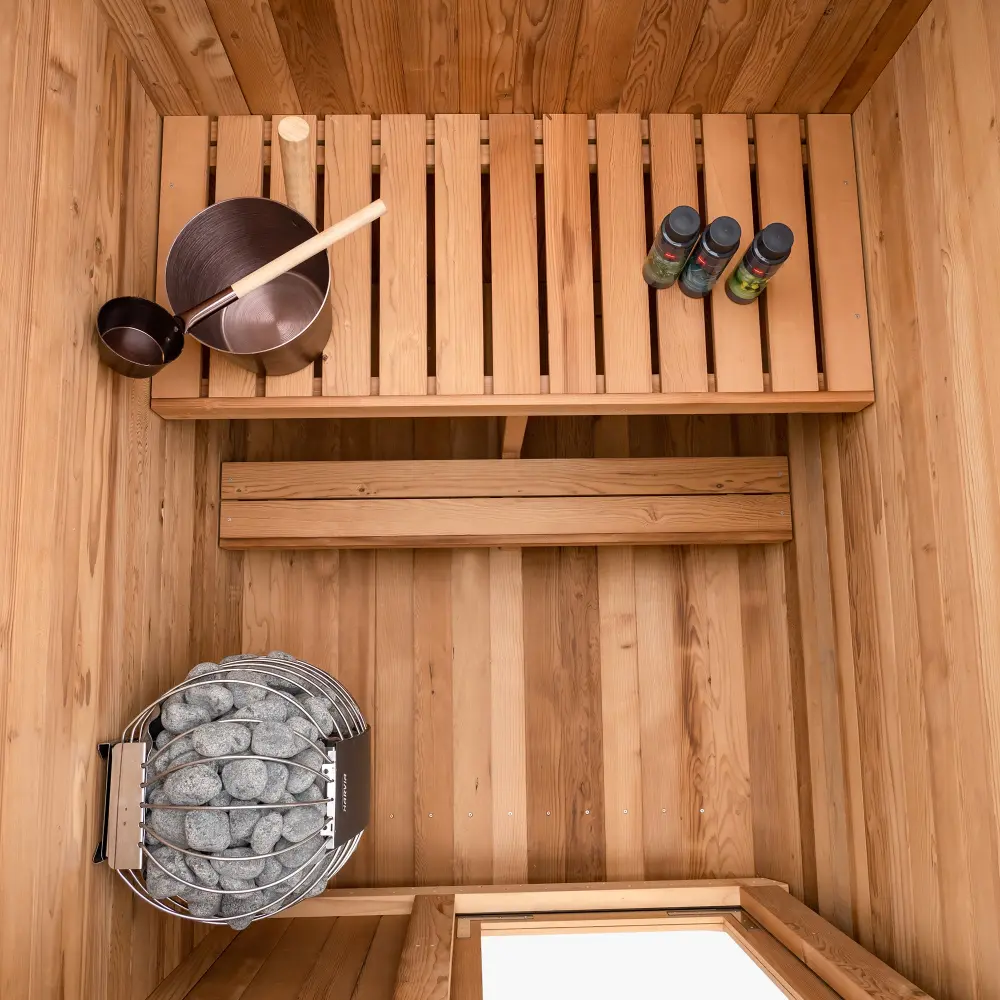
How long it actually takes, according to people who did it
The company says a few hours. Customer reviews on its own product pages give a wider and more useful range, and the spread is mostly about how many people are holding panels.
The best part of the Cove Sauna wound up putting it together. Think Lincoln Logs for adults!
Sandra, Cove Outdoor Sauna, May 18, 2026
Easy to fallow instructions built by myself in a couple of hours.
Les Beatty, Duo Outdoor Sauna, April 28, 2026. Quoted as written.
Instruction manual could be clearer about use of roof spacer(s). Poor quality screws (easy to strip). Qty of type E and F screws not sufficient. Two people can build in one day.
T Miller, Duo Outdoor Sauna, April 23, 2026
a DIY kit that my husband labored over for many hours
Verified buyer, Barrel Outdoor Sauna 6 Person, July 31, 2026
Take the four together and the honest answer is: a couple of hours for the smallest model with a methodical person, a full day for two people on a mid size unit, longer than expected on the 6 person Barrel. The variance is not really about skill. It is about whether you laid the parts out first.
Which is exactly what the manual asks you to do before you start, and the reason it asks is visible in the reviews above. Read the whole manual. Verify every piece against the parts list. Lay the pieces out in sections in the order the steps call for. The one review that mentions stripped screws and a short count of type E and F fasteners is describing a build that discovered a shortage partway through, which is a very different afternoon from one that discovered it at the start.
- Two people, not one, unless you are building the Duo.
- Count the fasteners against the parts list before the first panel goes up.
- The T20 bit matters. Driving torx screws with the wrong bit is how they get stripped.
- Follow the printed manual in your crate, not an older video. The designs change.
The electrician comes after the box is standing
This is the sequencing detail that saves a second weekend. The sauna and its power are two separate jobs, and they happen in that order: you assemble the structure, then the heater gets hardwired into it. One reviewer describes the exact halfway state, without meaning to:
The sauna set up smoothly and look beautiful. Still waiting for the electrical work and heater installation.
Laura Donahue, Duo Outdoor Sauna, December 16, 2025
A finished sauna waiting on an electrician is a normal state, and it is the most common way this project takes a month instead of a weekend. The fix costs nothing: book the electrician when you place the order, not when the build is done. By the time they arrive you want the structure up, the heater in position, and the panel question already answered from Check 1.
While you are booking, the two quotes advice is worth taking literally. This is the one line item on the project with no published price, and it is the one most sensitive to how far the sauna sits from your panel.
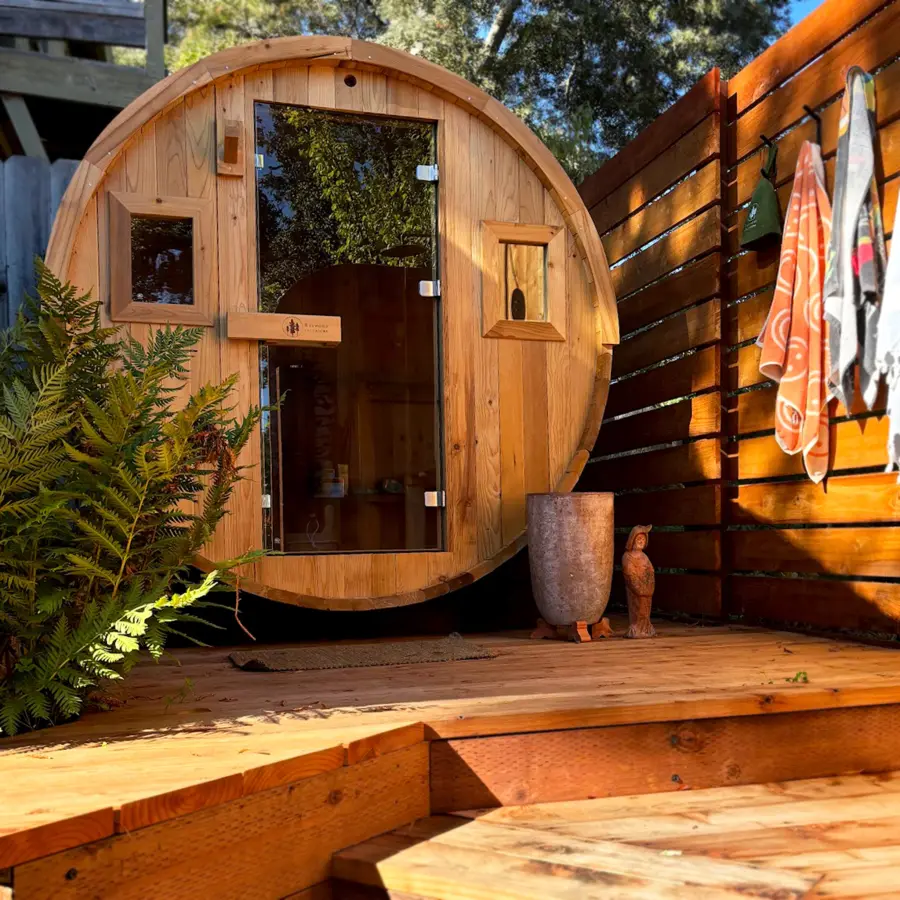
First heat, and the small jobs nobody mentions
Two things happen at the end that are easy to overlook when planning. The first is that you load the stones yourself. Rock capacity on the outdoor models is 132 lb for an 8kW heater and 176 lb for a 10.5kW, and sauna rocks are included with the sauna. That is a wheelbarrow's worth of stone to place by hand, and it happens after the electrician has gone.
The second is heat up time, which is the number that decides whether the sauna becomes a habit or a weekend object. One Cove owner is specific about it:
We upgraded to the 8kw Spirit Wifi heater and it gets to 185 in about 20-25 minutes. The convenience of being able to turn it on from your phone is such a nice feature. The app tells you when it's on, ready (at temp) and when it shuts off.
Mike Lesmes, Cove Outdoor Sauna, May 13, 2026
Twenty to twenty five minutes is the difference between a sauna you use on a Tuesday and one you use in July. It is also the strongest argument for the Wi-Fi heater options, which cost more up front and are the only upgrade on the list that changes how often the thing gets used rather than how it looks.
After that, maintenance is light and published: a water based stain maintains or changes the exterior color, the interior takes a light coating on benches and floor, and the heater exterior gets wiped down periodically. The sauna itself carries a 1 year limited warranty. Harvia heaters carry 1 year on heating elements and 5 years limited on other components for residential use, and Homecraft heaters carry 2 years limited.
The order of operations, on one screen
Everything above, sequenced so that nothing waits on anything else. Green steps are yours. Orange steps belong to somebody with their own calendar, which is why they start early.
Curb to first session
The sequence that keeps the two long poles, permits and electrician, off the critical path.
- 1Ask the permit and HOA questionBefore anything else, because it is the only step where somebody else sets the pace.Their calendar
- 2Have an electrician look at your panelConfirm there is room for a 30 to 50 amp 240V circuit, and get the run priced. Two quotes.Their calendar
- 3Choose the model against your access, not just your seatingNarrowest gap on the route versus crate width. The Duo ships wider than the Cove.Ten minutes with a tape measure
- 4Order, and book the electrician for two weeks outThe most common cause of a month long project is booking this at the end.Same day as the order
- 5Build the pad while the sauna is in transitConcrete, deck, compacted gravel or pavers. Level, drained, rated for sauna plus occupants.Free time, no crate in the way
- 6Take the delivery appointmentFreight calls ahead. Two tracking links. The crate lands at ground level at the end of the driveway.Be reachable
- 7Unpack, count the parts, lay them out, then buildTwo people. Six tools. The printed manual from inside the crate.A few hours to a day
- 8Electrician hardwires the heaterAlready booked in step 4, so it happens this week and not next month.Half a day
- 9Load the stones and run it132 lb of rock for an 8kW, 176 lb for a 10.5kW. Then about 20 to 25 minutes to temperature.First session
Steps 1, 2 and 4 are the whole trick. They cost nothing and they are the difference between a project measured in days and one measured in weeks.
What the project costs, line by line
Sauna and heater are sold separately, which is confusing at first and useful in practice: the heater is where you tune the budget without changing the building. Published prices for the outdoor range, plus the one line you have to price locally.
The stack
Published prices at redwoodoutdoors.com, read on August 13, 2026.
Redwood Outdoors offers Affirm financing with rates from 0 to 36% APR, and publishes this example: a $6,500 purchase might cost $271 per month over 24 months at 0% APR. Eligibility check applies and a down payment may be required. The company has also partnered with TrueMed so that HSA and FSA funds can be used toward a purchase.
Which model your yard is actually asking for
Seating capacity is the wrong first filter. Sort by footprint and crate width first, then look at how many people fit, because a sauna you cannot get into the yard seats nobody.
The five footprints, drawn to scale
Published exterior dimensions, seen from above, all anchored at the same corner. The gap between the smallest and the largest is the whole decision.
The Garden covers roughly two and a half times the ground of the Duo. The four smaller models sit within about two feet of each other in both directions, which is why access and crate width usually decide between them more than footprint does.
| Model | Seats | Footprint | Crate width | Weight | Price |
|---|---|---|---|---|---|
| Duo | 2 | 62.75 x 50.75 in | 50 in | 910 lb | $5,899 |
| Cove | 3 | 81.875 x 64.5 in base | 42 in | 1,000 lb | $6,199 |
| Barrel | 4 to 6 | 71 x 72.75 in | 45.5 in | 900 lb | $6,299 |
| Cabin | 4 | 78 x 67 in | 50.75 in | 1,150 lb | $7,299 |
| Garden | 6 to 8 | 89 x 89 in base | 90.5 in | 1,410 lb | $8,699 |
Dimensions, weights and prices as published on the product pages on August 13, 2026. Footprints are exterior dimensions, given at the base where the base and roof differ. The Duo, Cove and Cabin are Canadian Thermowood, the Barrel and Garden are heat treated hemlock. All five list 120V for lighting and 240V for the heater, and all ship in a wooden crate. A sixth outdoor model, the Grove, sits above these at $11,699.
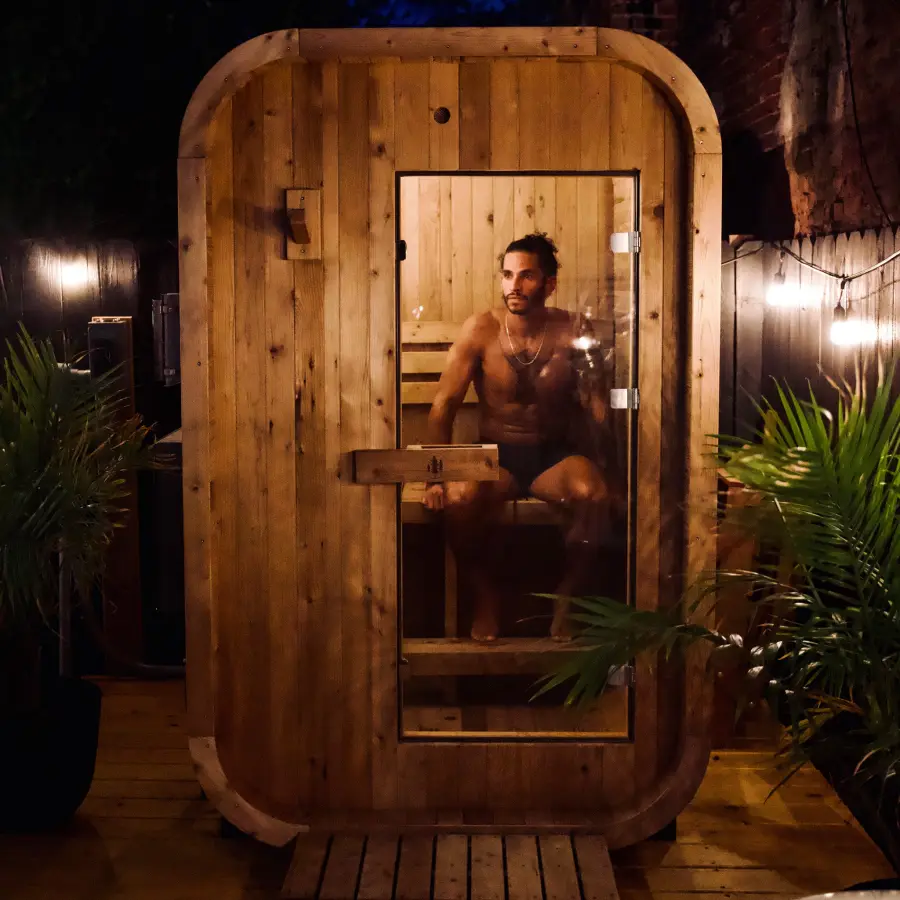 Duo, 2 personThe narrow yard answer. Smallest floor area in the range, and the model a reviewer reports putting up alone in a couple of hours.$5,899 See the Duo
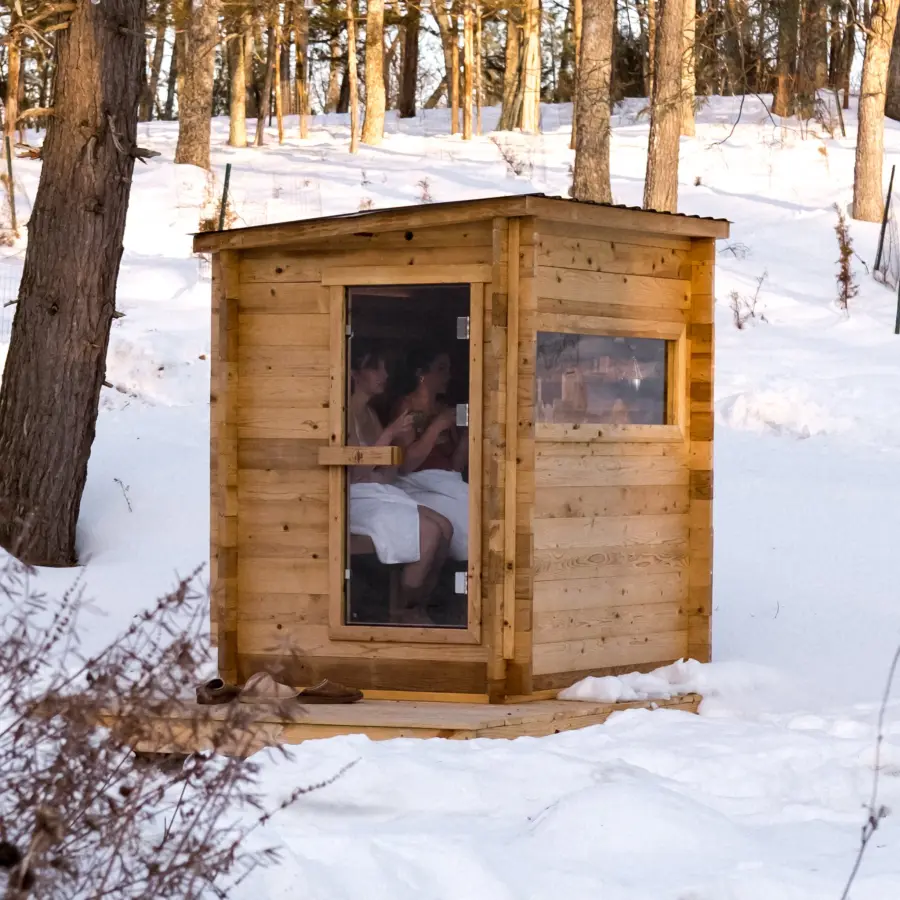 Cove, 3 personThe narrowest crate at 42 inches, so the easiest to get down a side passage. Tempered glass door.$6,199 See the Cove
Barrel, 6 personLightest in the range at 900 lb despite seating up to six. Sits on two cradles, so footings go under each one.$6,299 See the Barrel
Cove, 3 personThe narrowest crate at 42 inches, so the easiest to get down a side passage. Tempered glass door.$6,199 See the Cove
Barrel, 6 personLightest in the range at 900 lb despite seating up to six. Sits on two cradles, so footings go under each one.$6,299 See the Barrel
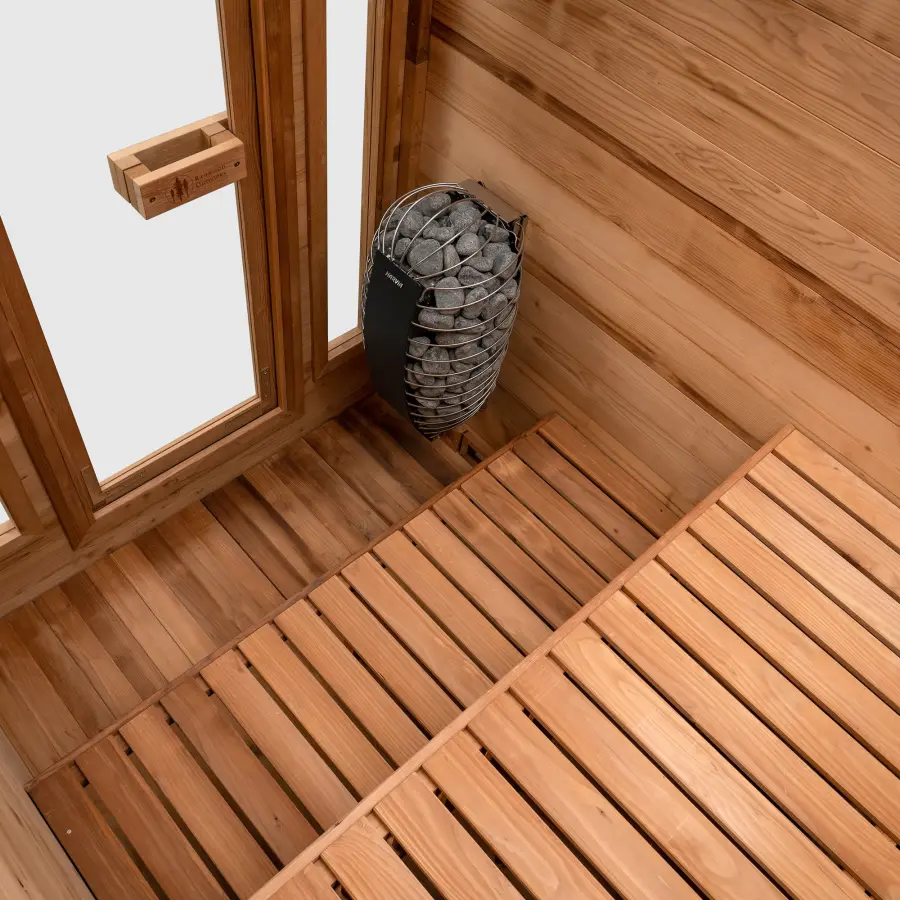 Cabin, 4 personTallest of the group at 92.5 inches, which is worth checking against fence heights and overhanging branches.$7,299 See the Cabin
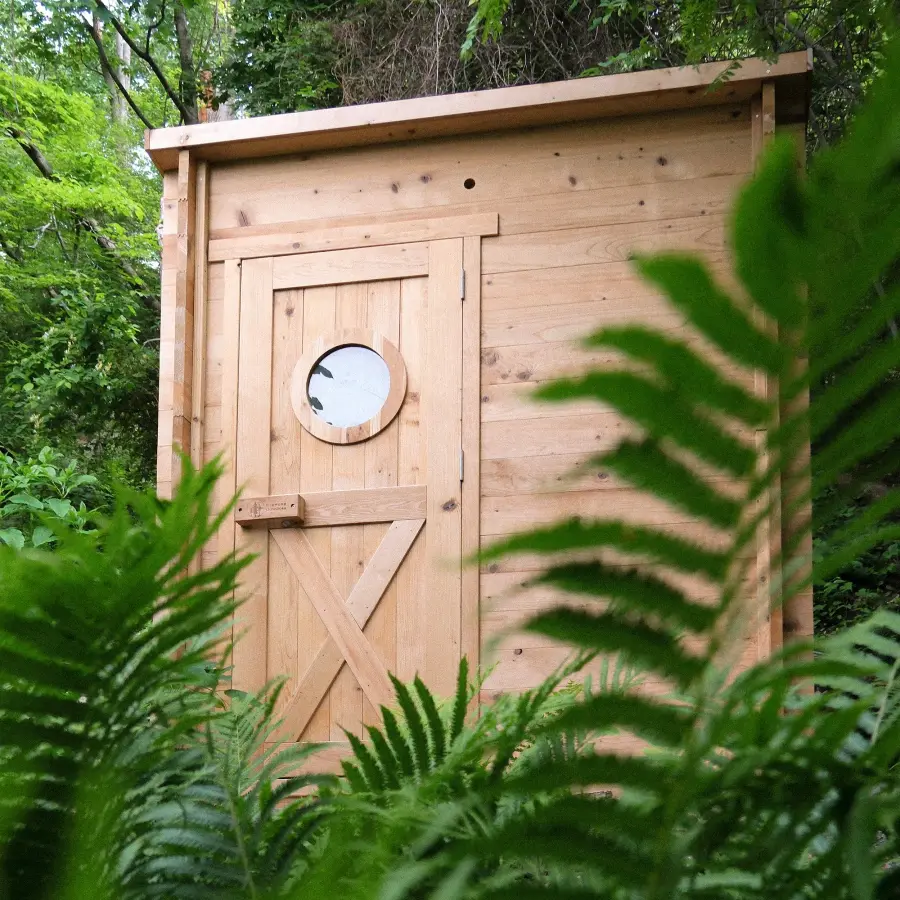 Garden, 6 to 8 personThe one with a genuine access constraint: at 90.5 inches the crate rules out most side passages. Plan a driveway or an open route.$8,699 See the Garden
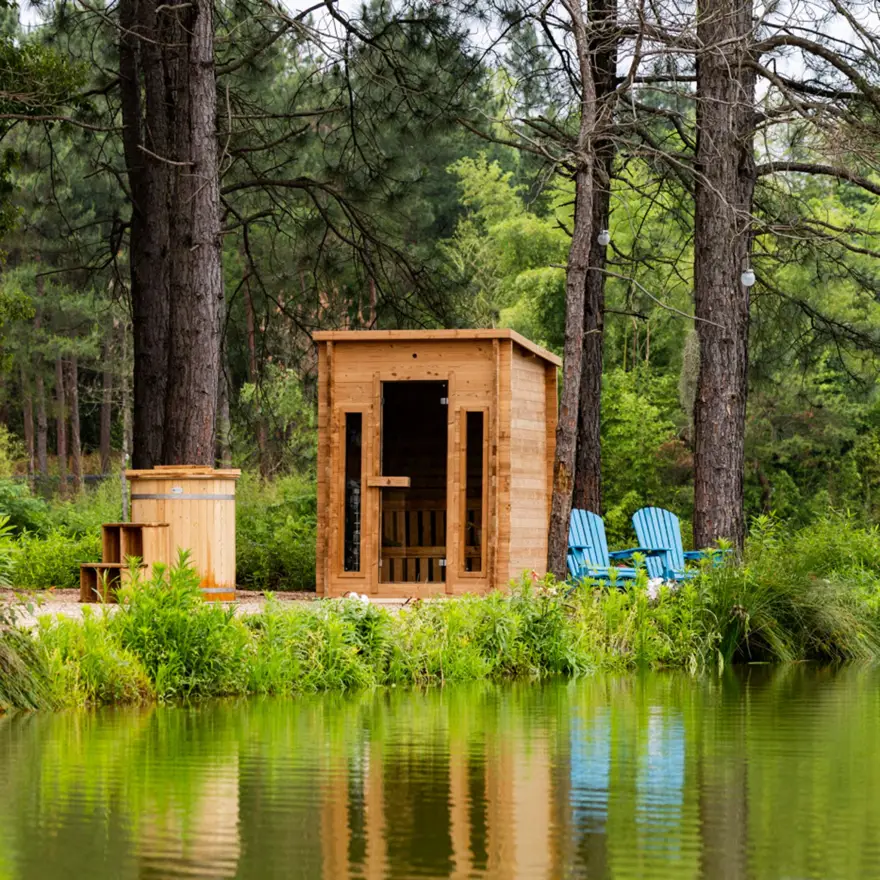 The full outdoor rangeEvery model page publishes its crate size, weight, wood type and power requirement, which is everything this article used.From $5,899 Compare all
Questions people ask before they order
Do I need a contractor?
For the sauna, no. The company states there is no cutting, no modifications and no special skills required, and the tool list is six household items. For the heater, yes: a licensed electrician is required, because it hardwires to your panel.
Will the truck bring it into the yard?
No. Delivery is curbside. The liftgate lowers the crate to ground level at the end of your driveway or the nearest accessible location. Moving it from there is your side of the line.
Can it go on my existing deck?
A solid deck or reinforced platform is one of the four approved bases, but the requirement is that it carries the full weight of the sauna and all occupants. That is 900 to 1,410 lb before anyone steps in.
Do I need a permit?
Possibly. Redwood Outdoors says a building permit or HOA approval may be required depending on location and asks you to check local regulations before installation. It is a phone call, and it is the first one to make.
What if I get stuck mid build?
A printed manual specific to your model is inside the crate, digital manuals and assembly videos are published online, and support is reachable on 1-800-567-8036 or at support@redwoodoutdoors.com before, during or after installation.
The whole thing, in one paragraph
Ask about permits, get an electrician to look at your panel, measure the narrowest gap between the curb and the spot, and choose the model that fits through it. Order, book the electrician the same day, and build the pad while the crate is in transit. Take the delivery, count the parts, lay them out, and put it up with a friend in an afternoon. Let the electrician wire the heater, load the stones, and wait twenty five minutes. That is the project. The only part that is genuinely hard is doing those steps in that order.
Start with the crate sizes and pick your modelFive outdoor saunas, from $5,899, every specification published